Over the past two months, I had the pleasure of giving two invited talks to rather different audiences in Taiwan. One was an academic seminar at Taipei Medical University, delivered via Zoom at 2 a.m. from Baltimore. The other was a popular science talk for high school students in Chiayi, Taiwan, during my visit in September. Both were memorable experiences, and I would like to share some of the highlights here.
October 23: Invited seminar at Taipei Medical University
On October 23, I was invited by Dr. Hui-Chuan Claire Chang to speak at the departmental seminar of the Graduate Institute of Mind, Brain and Consciousness (GIMBC) at Taipei Medical University (TMU).
Dr. Chang and I go back quite a long way. In 2017, we both worked in Dr. Uri Hasson’s lab at Princeton University. She was a postdoctoral researcher, while I was a research assistant preparing for my PhD applications. In fact, we had known each other even before Princeton, as her PhD advisor, Dr. Wen-Jui Kuo, and my master’s advisor, Dr. Fa-Hsuan Lin, were close collaborators. Our academic paths had crossed through research collaborations on language and naturalistic reading.
I have long admired Dr. Chang’s work on how the brain processes narratives, particularly her research on how information is accumulated and integrated over time during story comprehension. Her work on narrative processing and neural coupling during storytelling has been an inspiration for my own thinking about naturalistic cognition and shared brain responses. It was a pleasant surprise to hear from her again after all these years, and even better to have an opportunity to catch up.
The invitation also had a personal connection: my wife completed her undergraduate studies at TMU! It was quite a coincidence that I would eventually be invited to speak at her alma mater.
One thing that initially surprised me was that Dr. Chang specifically requested the talk to be given in English. After joining the Zoom meeting, I understood why. The audience appeared to consist predominantly of international students, with Taiwanese students making up a much smaller proportion than I had expected. I was delighted to see such an international student body at a graduate institute in Taiwan. To me, it was an encouraging sign of Taiwan’s growing international academic presence and its ability to attract students from around the world.
Because of the time difference, I had to give the talk at 2 a.m. Baltimore time. Fortunately, I had some experience with unusual working hours. During my training for Taiwan’s Alternative Civilian Service (a non-military form of national service), I had to take overnight shifts manning the security desk. That experience turned out to be unexpectedly useful!
The talk itself went rather smoothly. I have presented my research on the neuroscience of computer programming many times, and giving it in English allowed me to rely on familiar material. Admittedly, I suspect I was running on autopilot at a few moments during the latter half of the presentation.
Fortunately, the audience was remarkably engaged. The students and faculty asked many thoughtful questions, some of which led to genuinely interesting discussions. It was rewarding to exchange ideas with researchers approaching similar questions from different backgrounds. I only wish we could have had these conversations in person!
My sincere thanks to Dr. Chang for reaching out and organizing this opportunity. I hope to visit GIMBC in person someday.
September 23: Talking about AI with high school students
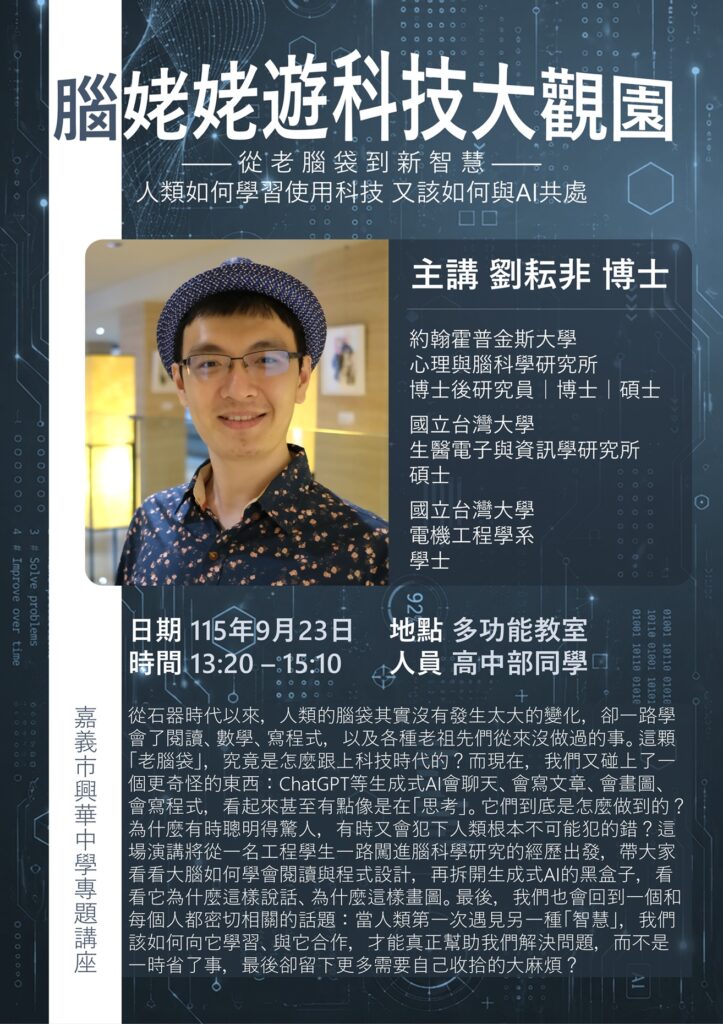
A month earlier, on September 23, I had a very different speaking experience at Hsing-Hwa Senior High School in Chiayi, Taiwan. I was invited by Dr. Chong-Hsu Wang (王崇旭), better known in Taiwan as 王宇老師 (Teacher Wang Yu), a prominent chemistry educator and entrepreneur who founded the Wang Yu Chemistry educational brand and subsequently expanded into educational technology. Dr. Wang previously served as chair of Hsing-Hwa’s board of directors and continues to serve on the board.
Dr. Wang reached out to me after reading our recently published commentary, Programming education in the AI era, in Nature Reviews Psychology. He was interested in bringing some of these ideas to his students and invited me to give a popular science talk on neuroscience and artificial intelligence.
I was very pleased that our commentary had attracted interest from an educator with such extensive experience in teaching and educational entrepreneurship. It was also a wonderful opportunity to bring my research to an audience I rarely get to interact with: high school students!
On the day of the talk, I received a warm welcome from the school’s principal, Mr. Yao-Wen Hsu, who kindly greeted me upon my arrival.
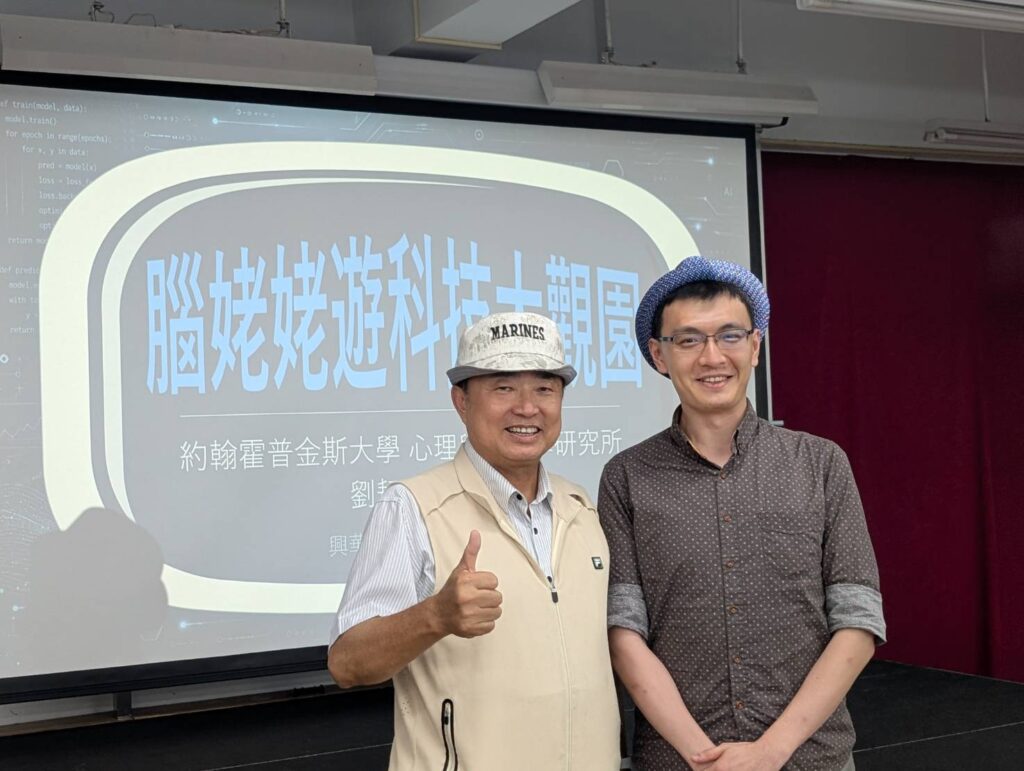
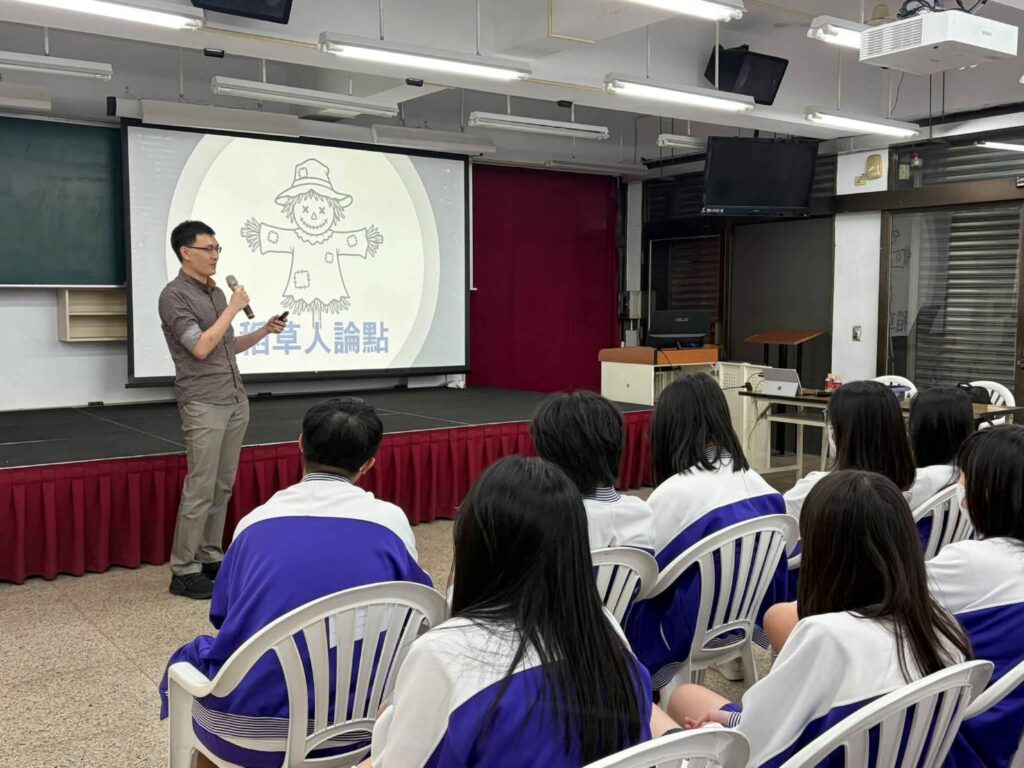
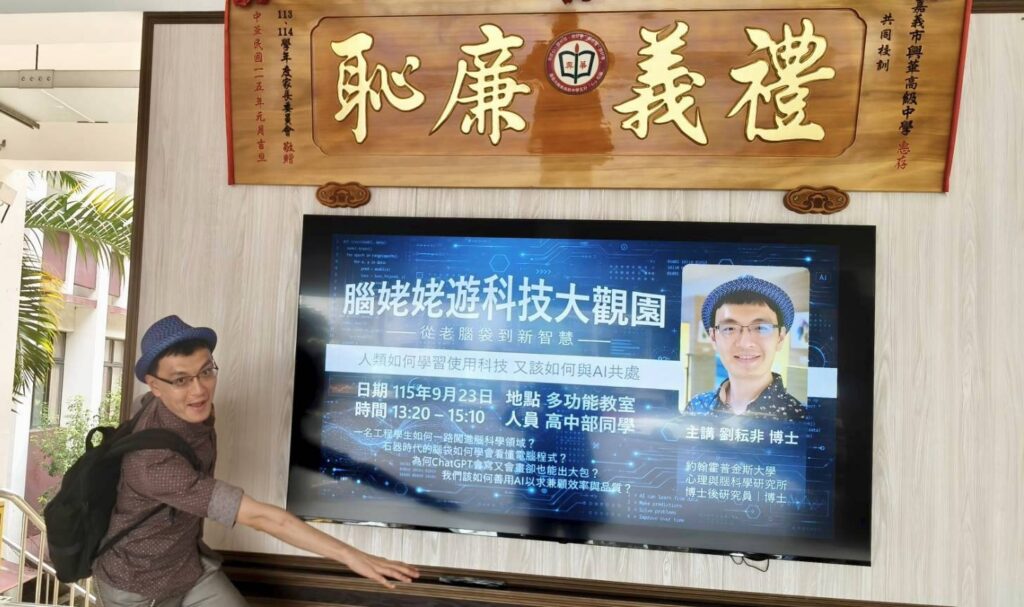
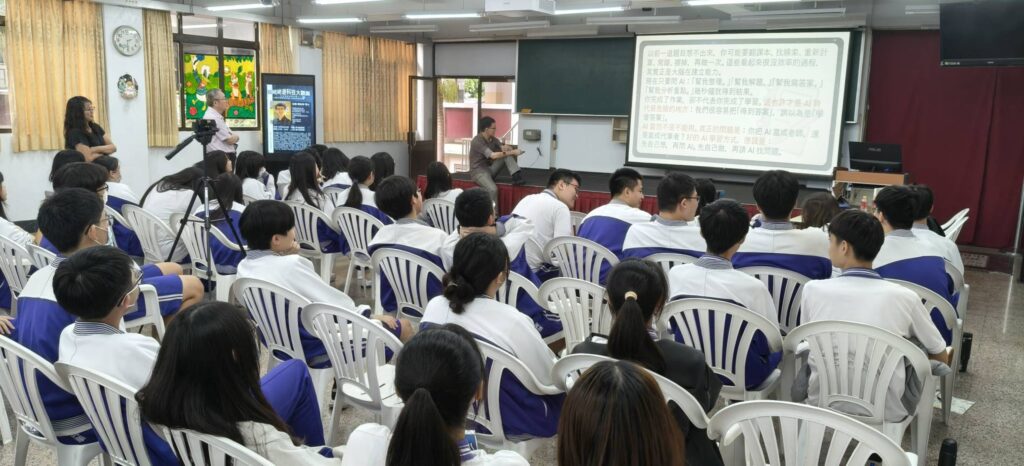
The talk was quite different from my usual academic presentations. To begin with, I would be speaking Mandarin Chinese, something I had not done professionally for a long time. I also wanted to make the material accessible and entertaining for teenagers, most of whom presumably had little prior exposure to neuroscience or the technical principles of artificial intelligence.
Consequently, I spent considerably more time preparing this talk than I normally would. I designed almost all the slides from scratch, carefully rehearsed the timing of my speech, planned interactive activities, and even created my own promotional poster. It was a great opportunity to exercise my creativity in my native language, particularly with memes, jokes, and cultural references that would have seemed rather out of place in an academic seminar.
I began the talk by introducing my research on how the human brain learns to understand computer programming, using it as a starting point to discuss how humans adapt to technologies that were invented long after our brains evolved. I then moved on to generative artificial intelligence, focusing primarily on ChatGPT, one of the most accessible generative AI services for Taiwanese high school students.
My goal was to help the students develop an accurate mental model of generative AI: how it works, what it is capable of, and where its limitations lie. I also wanted to share some thoughts on how to make productive use of AI tools while continuing to develop one’s own skills and knowledge.
I will discuss these ideas in greater detail in a separate post on AI usage, including a few mathematical-looking “inequalities” I proposed during the talk and my interpretation of Addy Osmani’s recently updated “80% problem” (previously called the “70% problem”) of AI-assisted coding.
For this talk, I wanted students to participate as much as possible. I invited them to answer some science and technology trivia, such as the approximate age of our species Homo sapiens and what the abbreviation LLM stands for.
I also shared a few rather embarrassing examples of my own attempts at using generative AI. For instance, I had tried using ChatGPT to design anime-style characters for an original story set in the World of Warcraft universe. Some of the results were surprisingly good, while others were hilariously far from what I had in mind. These failed attempts turned out to be useful material for explaining the limitations of AI-generated images. I also showed the students some truly horrifying AI-generated restaurant menus, featuring dishes that looked more likely to trigger trypophobia than an appetite.
Another activity involved asking students to read aloud passages of AI-generated articles that contained some of the most stereotypical ChatGPT writing patterns. I wanted them to hear how repetitive these patterns could become, and perhaps recognize them the next time they encountered AI-generated writing. Some of the passages sounded especially ridiculous when read aloud, which was precisely the effect I was hoping for!
It was great fun to explore these topics with a younger audience, and I particularly enjoyed the freedom to incorporate some humor and examples from my own hobbies. Judging from the students’ participation and reactions, I think they had a good time too.
I left Hsing-Hwa feeling refreshed and energized. Preparing this talk required quite a bit of effort, but seeing the students respond to the material made it all worthwhile. I hope I managed to spark their curiosity about neuroscience and artificial intelligence, and perhaps inspire them to become more thoughtful and responsible users of AI.
My sincere thanks to Dr. Wang for the invitation, to Principal Hsu or the warm welcome, and to the faculty and students at Hsing-Hwa for their hospitality and enthusiastic participation. It was a pleasure to spend a significant portion of my 2026 visit to Taiwan sharing my passion for science with the next generation.
These two talks reminded me how much I enjoy communicating science to people with different backgrounds. Whether discussing neural representations of algorithms with fellow researchers or showing high school students the bizarre things ChatGPT can produce, I always find it rewarding when a presentation leads to curiosity, questions, and a lively conversation.